Every EMS program eventually hits the same wall: your ECG rhythm generator subscription is up for renewal, and you're staring at a $150–200/yr invoice for a tool that runs a handful of rhythms on one screen.
Before you sign that renewal, it's worth knowing what a free alternative to paid ECG rhythm generators actually offers in 2026 because the gap between free and paid has closed a lot faster than most program directors realize.
Why Programs End Up Paying for a Rhythm Generator
Most paid ECG rhythm generators started as simple apps: pick a rhythm, display it, done. That's fine for basic rhythm-recognition drills with one instructor and one student.
But once a program scales past that multiple lab stations, back-to-back cohorts, several instructors running sessions in parallel the limitations show up fast. No multi-device sync. A capped rhythm library that repeats itself by week three. An annual invoice that renews automatically whether your program's budget grew or not.
Institutional-grade systems solve the scaling problem, but they solve it by pushing cost past $1,000/yr a number that requires committee approval most instructors and lab coordinators don't have direct control over. That leaves a lot of programs stuck paying mid-tier prices for a tool that still can't run a full classroom.
What Paid Tools Typically Include
At the $150–200/yr tier, most rhythm generators offer somewhere between 15 and 30 rhythm variations, a handful of vital channels beyond the raw ECG trace, and single-device operation meaning one instructor, one screen, one session at a time.
Institutional packages (typically $1,000+/yr) add more rhythms, additional vital channels, and multi-session support, but at a price point that puts them out of reach for community college programs, volunteer EMS agencies, and independent instructors funding their own equipment.
The pattern across almost every paid tier is the same: you're not just paying for rhythms, you're paying for scale and scale is exactly what gets locked behind the highest price bracket.
What You Get for Free with TrainingMonitor.App
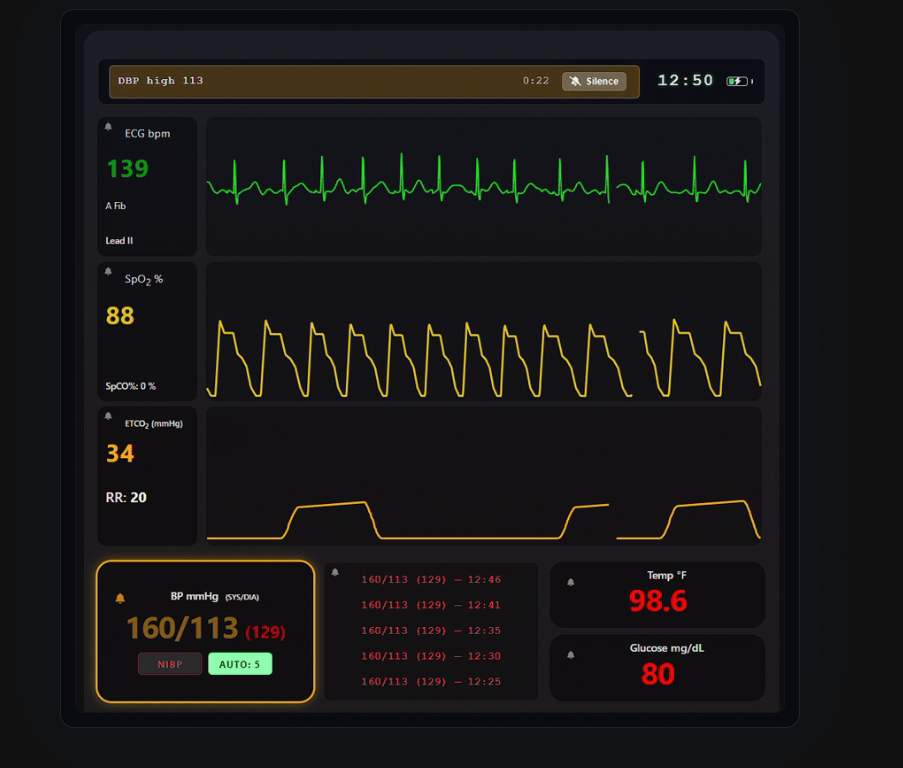
TrainingMonitor.App is a browser-based patient vitals monitor built specifically to close that gap no installs, no subscription, no credit card, and no feature locked behind a paywall. Here's how it stacks up against what programs are currently paying for:
| Capability | Paid Tools ($150–200/yr) | Institutional ($1,000+/yr) | TrainingMonitor.App (Free) |
|---|---|---|---|
| ECG rhythm variations | 15–30 | 50–75 | 200+ |
| Vital Channels | 5–7 | 8–12 | 16 |
| Capnography Waveforms | 1–3 | 4–16 | 15 |
| Multi-session control | ✗ | Some | ✓ (20 simultaneous) |
| Event log + export | Limited | ✓ | ✓ Full CSV export |
| Annual cost | $150–200 | $1,000+ | $0 |
Every rhythm, alarm, and scenario in TrainingMonitor.App is available from the very first session there's no premium tier hiding the features that actually matter for classroom teaching, and no per-seat pricing that punishes a program for growing.
Why the Multi-Session Feature Matters More Than It Looks
The single biggest cost difference between paid and free tools usually isn't the rhythm count it's multi-session control. Most $150–200/yr tools are built around one instructor running one scenario on one screen. If you're teaching four lab groups at once, that means either four separate subscriptions or four instructors improvising without the tool at all.
TrainingMonitor.App supports 20 simultaneous sessions from a single controller, with two-tier permissions separating who can control vitals and who can only view them. That single feature alone often costs more to replicate on a paid platform than the entire free version of TrainingMonitor.App.
When a Paid Tool Might Still Make Sense
To be fair to the paid options: if your program needs 12-lead ECG interpretation or synchronized cardioversion training right now, some paid and institutional tools already support that today.
TrainingMonitor.App has 12-lead ECG, manual defibrillation, and synchronized cardioversion on its public roadmap for the next release, but they aren't live yet. If that capability is a non-negotiable requirement for this semester's curriculum, it's worth knowing before you switch tools mid-term.
How to Make the Switch
Moving off a paid rhythm generator doesn't require migrating data, exporting old scenarios, or retraining staff on an unfamiliar interface the monitor display works the same way instructors already expect, with the same numeric readouts and waveform layout students see on real equipment.
Understanding what each waveform and numeric reading actually represents on screen makes the transition even faster; our guide on how to read a vital signs monitor walks through exactly that, so new instructors and students aren't relearning the display from scratch on day one.
Setting up your first session takes under a minute. Open the controller vital signs session on your phone or laptop, pick from the built-in scenario library or build vitals from scratch, and you're running a live simulation no renewal notice waiting in your inbox next year, and no purchase order to file before the semester starts.
Once the session is live, project the display monitor on the classroom screen and start teaching. That's the entire setup no license key, no install, no per-seat pricing to justify to your program director, and no downtime waiting on IT to approve new software.
Ready to stop paying for rhythm generation?
Start a Free Session on TrainingMonitor.App → No account. No credit card. No renewal invoice next year.
Frequently Asked Questions
Q. Is TrainingMonitor.App really free, with no hidden costs?
Yes, no paywalled features, no premium tier, and no account required, TrainingMonitor.App is sponsored by MedTechKits at no cost to instructors or students.
Q. Can TrainingMonitor.App replace a paid ECG rhythm generator entirely?
For rhythm recognition, alarms, and multi-session classroom use, yes it covers more rhythms and vital channels than most paid tools at the $150–200/yr tier.
Q. Does switching require any special hardware?
No, TrainingMonitor.App runs in any browser on a tablet, laptop, or phone, with no app install needed.
Q. Will I lose features by switching from a paid tool?
Only if your program specifically needs 12-lead ECG or synchronized cardioversion this semester both are on TrainingMonitor.App's roadmap but not yet live.
Q. How many rhythms does the free version include?
200+ ECG rhythm variations, from normal sinus rhythm to life-threatening arrhythmias.